
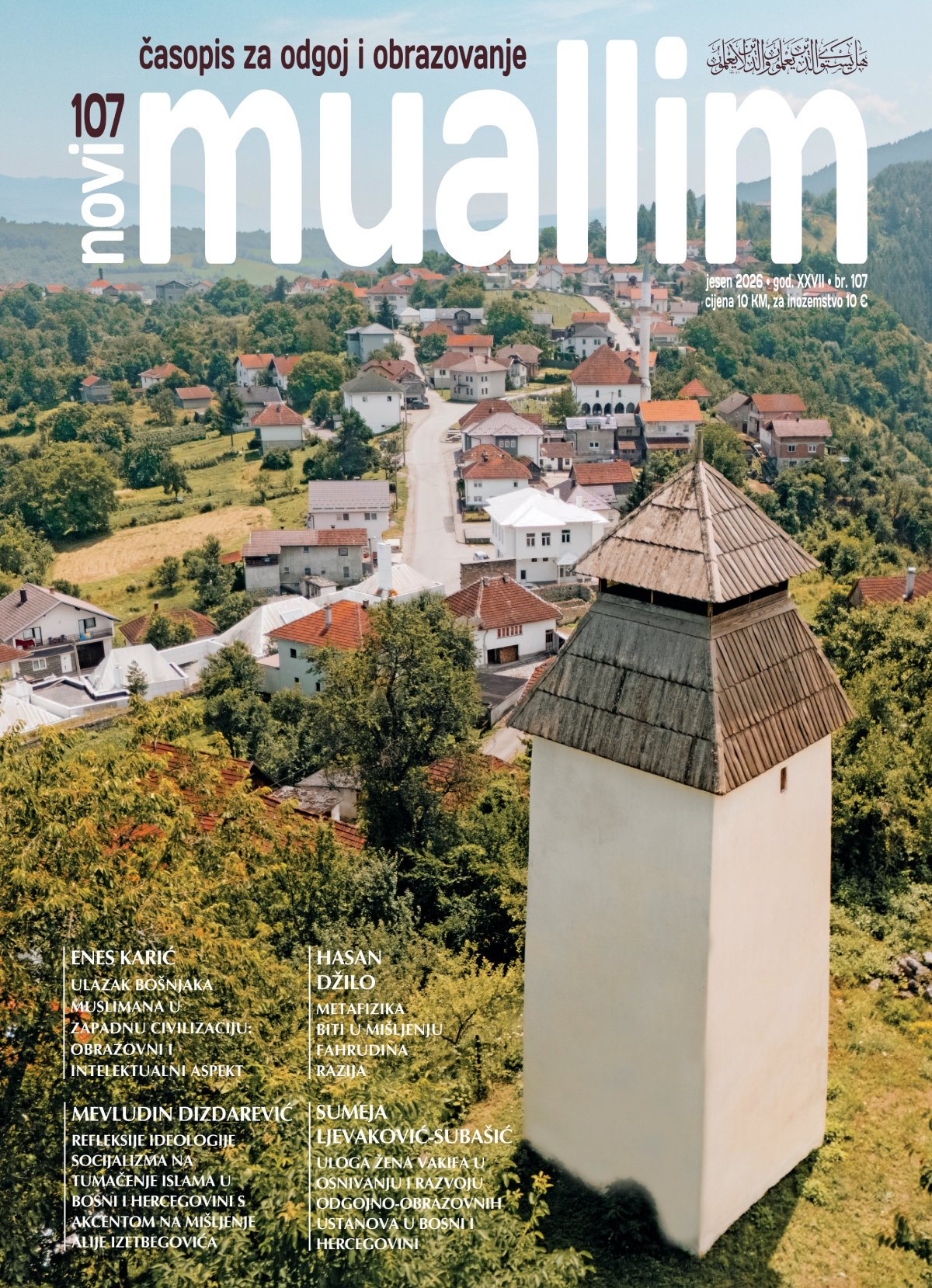
The Entry of Bosniak Muslims into Western Civilization: Educational and Intellectual Aspects
DOI:
https://doi.org/10.26340/muallim.v27i107.2247Keywords:
Islamic Community, modernity, Austria-Hungary, schooling, education, educational system, progressAbstract
UDK
323.1](497.6=163.4*3) "1878/1918"
94(497.6) "1878/1918"
The prevailing view in academic literature is that 1878 marked a turning point - or, as some would prefer to call it, a period of upheaval - for the Muslims of Bosnia and Herzegovina (Bosniaks) in terms of their entry into Western civilization. In order to begin and subsequently achieve integration into the orbit of Western civilization, between 1878 and 1918 Bosniaks became involved on their own initiative, or at the initiative of Austria-Hungary, in three distinct areas.
With the sponsorship of the Austro-Hungarian Empire, they established an autonomous Islamic Community on 17 October 1882, as an institution that provided contemporary forms of expression to the Islamic faith and the Bosnian-Herzegovinian Muslim identity, while also acknowledging the secular “spheres of society,” in accordance with the modern European patterns that were emerging at the time. During the Austro-Hungarian period, the institution of the Islamic Community initially contributed to the intellectual and educational formation of Bosnia and Herzegovina’s Muslims.
In accordance with the circumstances and needs of the time, cultural transformations took place. Bosniaks adopted both the Latin and Cyrillic scripts, developed intellectual and educational projects beyond the framework of the Islamic Community, and initiated numerous modern projects in education and culture. In this way, they adopted, in their own manner, the emerging currents of modernity through the establishment of a large number of reading rooms, clubs, and editorial offices of magazines and newspapers. Shortly thereafter, Bosniaks began establishing political parties.
Among the Bosniaks, a European (Western) educated intelligentsia gradually but persistently emerged, with many of them receiving their schooling in Vienna, Graz, Budapest, and Zagreb. At the same time, Bosniaks cooperated with the Austro-Hungarian authorities in establishing reformed educational institutions and educational establishments, such as the Teachers’ School (1882) and the Sharia Judicial School (1887). The work of the Dar al-Muallimin (1891–1892), as well as that of the gymnasium, was also modernized.
This essay provides a concise overview of the principal objectives and protagonists in these three significant areas, which address the entry of Bosniaks (Bosnian-Herzegovinian Muslims) into Western and European civilization.
Downloads
Published
How to Cite
Issue
Section
License

This work is licensed under a Creative Commons Attribution 4.0 International License.
Naknada:
a. Časopis ne naplaćuje naknadu za obradu članaka (APC) i naknadu za podnošenje članaka.
Autori koji objavljuju u ovom časopisu pristaju na sljedeće uvijete:
- Autori zadržavaju autorska prava i pružaju časopisu pravo prvog objavljivanja, pri čemu će rad jednu godinu po objavljivanju biti podložan licenci Creative Commons imenovanje koja omogućuje drugima da dijele rad uz uvijet navođenja autorstva i izvornog objavljivanja u ovom časopisu.
- Autori mogu izraditi zasebne, ugovorne aranžmane za ne-ekskluzivnu distribuciju rada objavljenog u časopisu (npr. postavljanje u institucionalni repozitorij ili objavljivanje u knjizi), uz navođenje da je rad izvorno objavljen u ovom časopisu.